
Notice that the therapist is systematic in his responses; he identifies the nominalizations, and
(a) Turns the noun word back into a verb word:

(b) Assumes that Dave is one of the deleted parts of the nominalization:
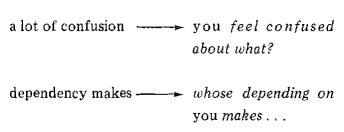
(c) Asks for the other part of the nominalization which has been deleted:
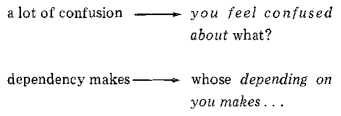
There are two ways which we have found very useful in our work to systematically identify and challenge nominalizations in the communications of family members in the context of family therapy. First, people are unable to cope when they represent processes in their experience as events, static and fixed, having deleted most of the information about the parts which went to make up that process. If the missing something which they want in their lives is represented as a process with the parts of that process identified, then there is a possibility for them to act to influence and change the process to get what they want. Understanding how they arrived at the place in their lives where they are now helps them to identify the next step toward getting what they want for themselves. If, however, the thing they want is represented as an event with most of the pieces missing, they have little hope of influencing and changing it. They, literally, are victims of their representation. When the nominalizations are converted into process representations and the pieces of the process are identified, coping becomes possible. Dave feels confused about what he is to do when Marcie looks at him in a certain way. Understanding the specific process by which "a lot of confusion" is created is an important first step in changing it.