
AGA Rules Committee
Official AGA Rules of Go
September 1, 1991
{The following are the American Go Association Rules of Go for amateur play. Unless specifically stated otherwise, these rules are in effect at all AGA sanctioned events. The rules themselves are given in boldface; comments and examples are given in ordinary type [and surrounded with curly braces or parentheses]. Illustrative figures are [interspersed].}
Any paraphrase of these rules which is identical in content is acceptable as a statement of the AGA Rules of Go so long as it makes reference to the more complete Official Rules given below. (By "identical in content" we mean that the result of applying these paraphrased rules should give the same result as would the Official Rules in every situation.)
{These rules are supplemented by the Official AGA Tournament Regulations governing time control, player conduct, the role of monitors, etc.}
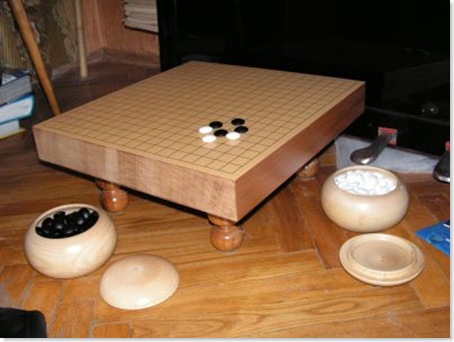
1) The Board and Stones: Go is a game of strategy between two sides usually played on a 19x19 grid (the board). The game may also be played on smaller boards, 13x13 and 9x9 being the two most common variants. The board is initially vacant, unless a handicap is given (see Rule 4). The two sides, known as Black and White, are each provided with an adequate supply of playing tokens, known as stones, of the appropriate color.
{For recording purposes, the horizontal lines on the board are designated 1,2,3,…,19, starting from the bottom as seen by Black. The vertical lines are designated A,B,C,…,T (skipping 'I'), starting from the left as seen by Black. Points on the board are identified by their coordinates, c.g. A-1, C-3, T-19, etc.}
2) Play: The players alternate in moving, with Black playing first.