
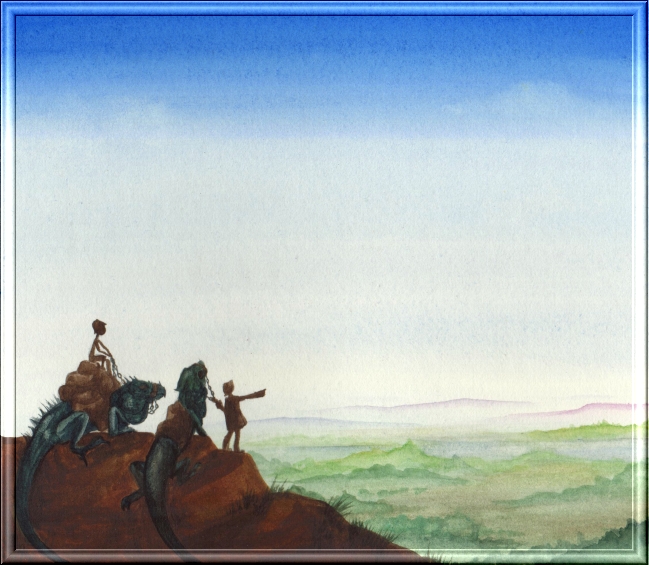
The valley that lay beyond the second ridge was entirely different from the faded fields behind the two travellers. In the warm twilight, they saw a checkerboard of green and gold, full fields of wheat interspersed with meadows heavily stocked with fat cattle. A broad river wound through from the east, spilling its banks in several places into fecund wetlands that were rich with waterfowl. Several small hillocks in the valley were covered in apple trees, dark foliage heavily flecked with the bright green of vast quantities of emerald fruit. There were citrus groves too, stone-walled clumps of smaller trees laden with lemons or limes, and only a hundred yards away, a group of six trees bearing the rare and exquisite blue-skinned fruit known as serqa which was normally only found in drier climes.
“A most pleasant vista,” said Hereward. A small smile curled his lip and touched his eyes, the expression of a man who sees something that he likes.
Shûme itself was a mile away, built on a rise in the ground in the northwestern corner of the valley, where the river spread into a broad lake that lapped the city’s western walls. From the number of deep-laden boats that were even now rowing home to the jetties that thronged the shore, the lake was as well stocked with fish as the valley was with livestock and produce.
Most of the city’s buildings were built of an attractively pale yellow stone, with far fewer timber constructions than was usual for a place that Hereward reckoned must hold at least five thousand citizens.
Shûme was also walled in the same pale stone, but of greater interest to Hereward were the more recent earthworks that had been thrown up in front of the old wall. A zigzag line of revetments encircled the city, with respectably large bastions at each end on the lakeshore.