
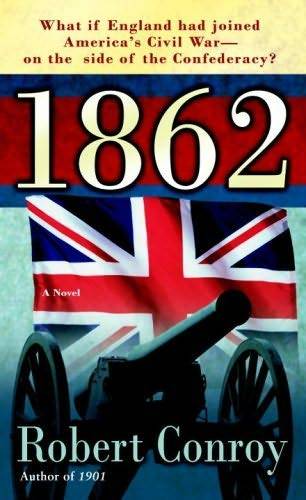
Robert Conroy
1862
Copyright © 2006 by Robert Conroy
INTRODUCTION
“YOU MAY STAND for this, but damned if I will” snarled an outraged Lord Palmerston: prime minister of England, to his cabinet in late 1861. He was referring to the Trent Incident, and while not quite a declaration of war, his statement showed the depths of his and England's anger.
Today we are almost blinded to past realities by the so-called Special Relationship between the United States and Great Britain. We have fought side by side in two world wars and numerous other actions. England is the closest thing we have to a friend in the world. It was not, however, always so. We fought England twice and nearly came to blows on several other occasions. England in the nineteenth century saw us as an upstart and a rival. Our government frightened her. Democracy as we practiced it was raw and brawling in the eyes of the British ruling class. They feared the British lower classes would be infected by the contagion.
Thus, the possibility of England entering the war on the side of the Confederacy was very real, and the Trent Incident, the seizure of a British mail packet by the U.S. Navy, was an opportunity almost too good for Queen Victoria's government to pass up. The War Between the States was threatening the English economy. Something had to be done. Only the fact that the Confederacy would not let go of its slaves stood in the way, but the Trent Incident almost provided a casus belli that overrode that inconvenient fact.
Of course, cooler heads prevailed and the war never happened. Conventional wisdom has generally held that Britain's entry into our Civil War would have tipped the scale on the side of the Confederacy and we would now be two nations. But England was severely stretched militarily at the time, and it might not have been the easy victory that some have envisioned. Indeed, it might not have been a British victory at all.