
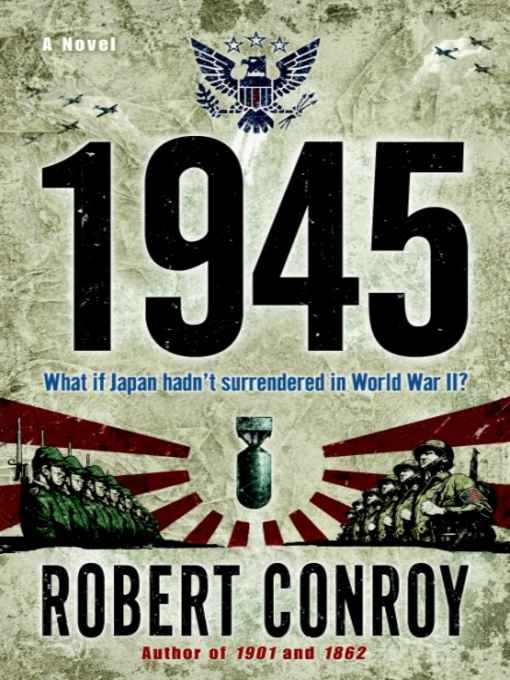
Robert Conroy
1945
Copyright © 2007 by Robert Conroy
Acknowledgments
As always, I am thankful to my wife, Diane, my daughter, Maura, and friends for their support of my lifelong dream of having a career in writing, however belated.
And thanks to Tim Mak for his insights into editing, and Ron Doering for buying the book in the first place.
Introduction
By the summer of 1945, the Japanese were thoroughly and utterly defeated. Their cities were rubble, their navy nonexistent, their economy destroyed, and their people near starvation. By all rights, they should have surrendered.
But surrender wasn't in the vocabulary of the militarists who ran the nation. They lived by the code of Bushido, which condemned surrender. Instead, they wished to fight until an honorable peace was achieved and felt they had good reasons for doing so.
First, they considered the recent agreement among the Allies, the Potsdam Declaration, to be a plan to destroy both Japan and her culture. This was intolerable to them.
Second, they considered any possible occupation of Japan and any subsequent war crimes trials to be mortal insults. So too were any thoughts of making the powers of the emperor subject to the will of the people. After all, didn't the emperor own the people?
Third, a few were pragmatic and felt that defeat would mean their personal doom.
Many in the military felt otherwise, and a great number of the civilian government and population wanted peace, but these people were powerless to do anything about it. In the naïve and racist hatreds of the day, many Japanese thought that the Americans would rape, murder, and then cannibalize Japanese dead.
It took the shocks of the nuclear assaults on Hiroshima and Nagasaki, along with the Soviet attack into Manchuria and elsewhere, to give the Japanese peace movement the motivation and the rationale to seek peace.