
I call to the captain to take me ashore immediately.
He grumbles. The fishing is good, the day still young. I offer him more money. Reluctantly, he agrees. He calls orders to his sons to put the boat about and head in.
I stand in the bow. Let him have a good look. I send my anger on ahead. The sword is as sacred an object as the mirror.
As Fuji grows before me the man glances in our direction, hands something to the others, then turns and ambles away. No! There is no way to hasten our progress, and at this rate he will be gone before I reach land. I curse. I want immediate satisfaction, not extension of mystery.
And the men with whom he was speaking . . . Their hands go to their pockets, they laugh, then walk off in another direction. Drifters. Did he pay them for whatever information they gave him? So it would seem. And are they heading now for some tavern to drink up the price of my peace of mind? I call out after them but the wind whips my words away. They, too, will be gone by the time I arrive.
And this is true. When I finally stand upon the beach, the only familiar face is that of my mountain, gleaming like a carbuncle in sun’s slanting rays.
I dig my nails into my palms but my arms do not become wings.
9. Mt. Fuji from Naborito
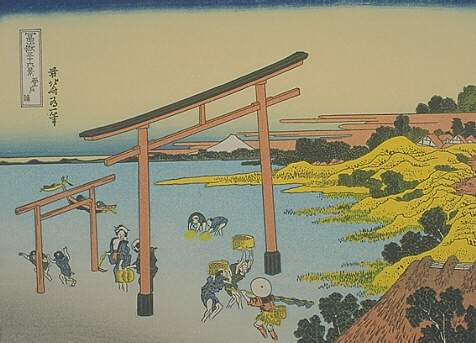
I am fond of this print: the torii of a Shinto shrine are visible above the sea at low tide, and people dig clams amid the sunken ruins. Fuji of course is visible through the torii. Were it a Christian church beneath the waves puns involving the Clam of God would be running through my mind. Geography saves, however.
And reality differs entirely. I cannot locate the place.
I am in the area and Fuji properly situated, but the torii must be long gone and I have no way of knowing whether there is a sunken temple out there.