
I shake my head. It is an answer that is no answer. He shakes his head back at me and points again.
The clouds are massing high above Fuji, but that is no answer. I study them for a long while but can trace no interesting images within.
Then I drop my eyes. Below me, inverted, they take a different form. It is as if they depict the clash of two armed hosts. I watch in fascination as they flow together, the forces from my right gradually rolling over and submerging those to my left. Yet in so doing, those from my right are diminished.
Conflict? That is the message? And both sides lose things they do not wish to lose? Tell me something I do not already know, old man.
He continues to stare. I follow his gaze again, upward. Now I see a dragon, diving into Fuji’s cone.
I look below once again. No armies remain, only carnage; and here the dragon’s tail becomes a dying warrior’s arm holding a sword.
I close my eyes and reach for it. A sword of smoke for a man of fire.
13. Mt. Fuji from Koishikawa in Edo
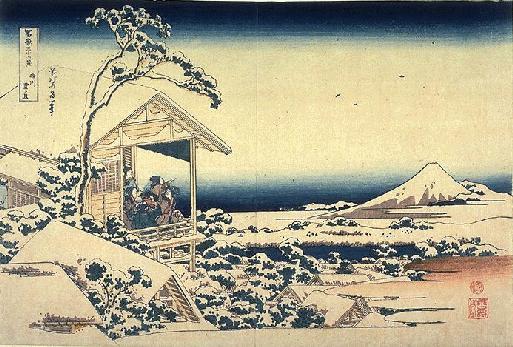
Snow, on the roofs of houses, on evergreens, on Fuji—just beginning to melt in places, it seems. A windowful of women—geishas, I would say—looking out at it, one of them pointing at three dark birds high in the pale sky. My closest view of Fuji to that in the print is unfortunately snowless, geishaless, and sunny.
Details . . .
Both are interesting, and superimposition is one of the major forces of aesthetics. I cannot help but think of the hot-spring geisha Komako in Snow Country–Yasunari Kawabata’s novel of loneliness and wasted, fading beauty—which I have always felt to be the great anti-love story of Japan. This print brings the entire tale to mind for me. The denial of love. Kit was no Shimamura, for he did want me, but only on his own highly specialized terms, terms that must remain unacceptable to me. Selfishness or selflessness? It is not important . . .