
He shook his head, still smiling.
“But it is that particular flow that I am going with. I am getting farther and farther into it. You should try it sometime. There have been moments when I felt I could translate myself into it.”
“Linguistically or theologically?”
“Both,” he replied.
And one night he did indeed go with the flow. I found him in the morning—sleeping, I thought—in his resonance couch, the helmet still in place. This time, at least, he had shut down our terminal. I let him rest. I had no idea how late he might have been working. By evening, though, I was beginning to grow concerned and I tried to rouse him. I could not. He was in a coma.
Later, in the hospital, he showed a flat EEG. His breathing had grown extremely shallow, his blood pressure was very low, his pulse feeble. He continued to decline during the next two days. The doctors gave him every test they could think of but could determine no cause for his condition. In that he had once signed a document requesting that no heroic measures be taken to prolong his existence should something irreversible take him, he was not hooked up to respirators and pumps and IVs after his heart had stopped beating for the fourth time. The autopsy was unsatisfactory. The death certificate merely showed: “Heart stoppage. Possible cerebrovascular accident.” The latter was pure speculation. They had found no sign of it. His organs were not distributed to the needy as he had once requested, for fear of some strange new virus which might be transmitted.
Kit, like Marley, was dead to begin with.
15. Mt. Fuji from Tsukudajima in Edo
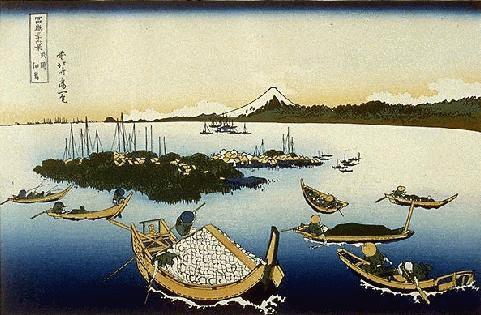
Blue sky, a few low clouds, Fuji across the bay’s bright water, a few boats and an islet between us. Again, dismissing time’s changes, I find considerable congruence with reality. Again, I sit within a small boat. Here, however, I’ve no desire to dive beneath the waves in search of sunken splendor or to sample the bacteria—count with my person.