
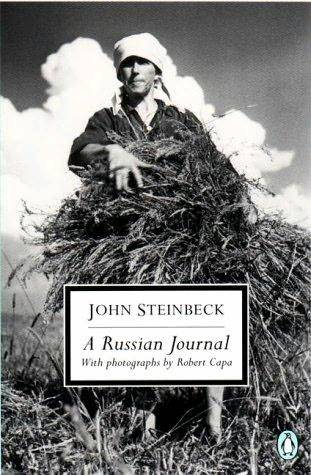
John Steinbeck
A Russian Journal
© 1948
INTRODUCTION
IN 1946, WINSTON CHURCHILL announced that an "Iron Curtain" I had been drawn closed across Eastern Europe. In the winter of 1947, the cold war began in earnest. The Soviet Union, fierce ally of 1 the United States in World War II, had become a menacing presence, a foe barely understood. "In the papers every day," John Steinbeck begins his text, "there were thousands of words about Russia," and yet, he continues, "there were some things that nobody wrote about Russia, and these were the things that interested us most of all." His quest, and that of photographer Robert Capa who accompanied him, was to discover the "great other side," the "private life of the Russian people." Steinbeck and Capa's modest book about the lives of Russians, A Russian Journal, published in 1948, attempts only "honest reporting, to set down what we saw and heard without editorial comment, without drawing conclusions about things we didn't know sufficiently."
In many ways, that is what John Steinbeck had been doing quite successfully for twenty years, writing books about ordinary people: paisanos, Oklahoma migrants, enlisted men in World War II, Mexican peasants. A Russian Journal does not sound the epic chords of I The Grapes of Wrath, certainly, but it has some of that book's empathy and humanity. Indeed, one explanation for the appeal of A 1 Russian Journal is that this book, unlike so many other accounts of I Russia published at the time, engages and informs in Steinbeck's I most characteristic manner: expressing empathy and understanding I for working people; capturing with a journalist's eye the telling de-1 tail; seeing "nonteleologically," recording merely what is witnessed; 1 and finally leavening the narrative with a wry humor absent in I many more ponderous contemporary accounts of travel through I Soviet-approved locales. If not the most erudite or wide-ranging I book about postwar Russia, Steinbeck and Capa's is just what they claimed for it: "It is not the Russian story, but simply a, Russian story."