
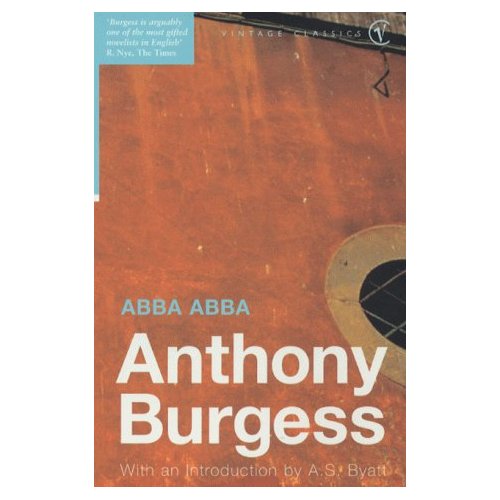
Anthony Burgess
ABBA ABBA
To Liana
I would reject a petrarchal coronation – on account of my dying day, and because women have Cancers.
– John Keats
Introduction
Anthony Burgess's novels often seem to be a tussle with the art of poetry. His costive poet, Enderby, grinds out in the lavatory poems of metaphysical grim wit which turn out to be Burgess's own early work, at least in part. Enderby embarks on epics about the conflict between St Augustine and the heretical Celt, Pelagius. The Clockwork Testament, or Enderby's End plays a wildly funny film-script of G. M. Hopkins's The Wreck of the Deutschland across the illiterate transcription of a television chat show by a hopelessly defeated Californian secretary. Burgess's novels about Shakespeare and Marlowe are shot through with overt and covert quotations from the works of those – and other – dramatists. He was given to chiding his reviewers and readers for not noticing complicated musical forms encoded in his works. As he grew older he came to doubt that his readers would any more have the familiarity with the body of poetry in English he took for granted. But even if we cannot recognise everything we can respond to the furious susurration of other vocabularies and rhythms, the counterpoint, the polyphony.
Why did he do it? He described himself, modestly enough, as a maker of verse rather than poetry. He wrote libretti, and a splendid translation of Cyrano de Bergerac, complete with murderous sonnets. He was a trained linguist, and thought technically about sounds and rhymes in a way most novelists don't. He was driven to manic punning and word-play in the same way as his hero Joyce, and Melville, perhaps, another novelist who kept breaking into verse and parody.