
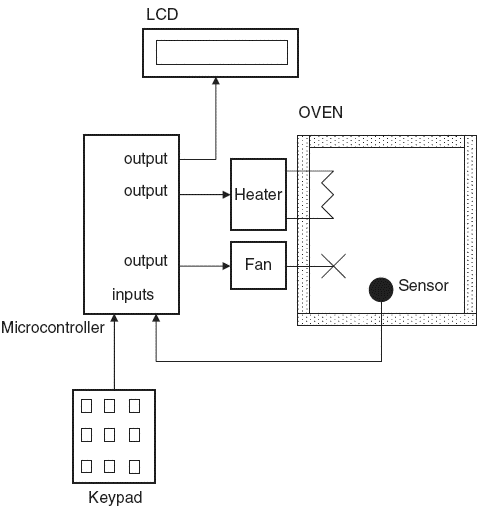
Figure 1.2: Temperature control system with a keypad and LCD
We can make the design even more sophisticated (see Figure 1.3) by adding an alarm that activates if the temperature goes outside the desired range. Also, the temperature readings can be sent to a PC every second for archiving and further processing. For example, a graph of the daily temperature can be plotted on the PC. As you can see, because microcontrollers are programmable the final system can be as simple or as complicated as we like.

Figure 1.3: A more sophisticated temperature controller
A microcontroller is a very powerful tool that allows a designer to create sophisticated input-output data manipulation under program control. Microcontrollers are classified by the number of bits they process. Microcontrollers with 8 bits are the most popular and are used in most microcontroller-based applications. Microcontrollers with 16 and 32 bits are much more powerful, but are usually more expensive and not required in most small-or medium-size general purpose applications that call for microcontrollers. The simplest microcontroller architecture consists of a microprocessor, memory, and input-output. The microprocessor consists of a central processing unit (CPU) and a LCD control unit (CU). The CPU is the brain of the microcontroller; this is where all the arithmetic and logic operations are performed. The CU controls the internal operations of the microprocessor and sends signals to other parts of the microcontroller to carry out the required instructions.
Memory, an important part of a microcontroller system, can be classified into two types: program memory and data memory. Program memory stores the program written by the programmer and is usually nonvolatile (i.e., data is not lost after the power is turned off). Data memory stores the temporary data used in a program and is usually volatile (i.e., data is lost after the power is turned off).