
As the therapist goes about the task of assisting the family members in understanding what they seek, he sets a model for clear communication. In the verbal exchange, he can check the verbs which the family members use to describe their experience, requesting that they specify these process descriptions until he can make sense out of their narrations. Again, extracting from the transcript, we have,
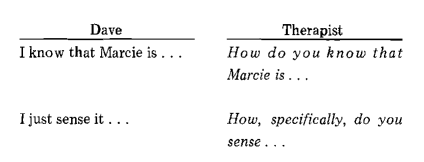
By systematically insisting that he be able to understand the messages from individual family members, the therapist is setting an example for clear communication as well as teaching the family members specific ways to clear up their verbal communication.
Therapist: Dave, what are you aware of right now?
Dave: I feel kinda tight . . . stomach flipping around; you know . . . when Marcie looks at me that way, I
feel kinda funny.
Therapist: Funny how?
Dave: You know, there's a lot of confusion . . . dependency makes me feel tight.
Therapist: You feel confused about what, Dave?
Dave: You know . . . dependency makes me feel confused . . .
Therapist: Whose depending on you makes you feel confused?
Human speech is one door to understanding between the speaker and the one to whom it is spoken. Understanding how human speech reflects this is an essential tool for therapists. We will, therefore, go into detail to show how this concept is illustrated in this interview.
There are several important patterns in this portion of the transcript. First of all, Dave has begun to use a language pattern known as nominalization.