
Thanks to John Baez,Jennifer Brehl, Caroline Oakley, Anthony Cheetham, John Douglas, SimonSpanton, Oisín Murphy-Lawless, Devi Pillai, Peter Robinson,Russell Galen, Carol Jackson, Emma Bailey, Diana Mackay, PhilipPatterson, Christodoulos Litharis, Nicola Fantini, Giancarlo Carlotti,Albert Solé, Petr Kotrle, Makoto Yamagishi, Florin Pîtea,and Mihai-Dan Pavelescu.
Part One
Chapter 1
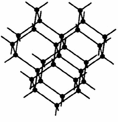
In the beginning was a graph, more like diamond thangraphite. Every node in this graph was tetravalent: connected by fouredges to four other nodes. By a count of edges, the shortest path fromany node back to itself was a loop six edges long. Every node belongedto twenty-four such loops, as well as forty-eight loops eight edgeslong, and four hundred and eighty that were ten edges long. The edgeshad no length or shape, the nodes no position; the graph consisted onlyof the fact that some nodes were connected to others. This pattern ofconnections, repeated endlessly, was all there was.
In the beginning? Waking morefully, Cass corrected herself: that was the version she remembered fromchildhood, but these days she preferred to be more cautious. TheSarumpaet rules let you trace the history of the universe back to thevicnity of the Diamond Graph, and everything you could ask for in a BigBang was there: low entropy, particle creation, rapidly expandingspace. Whether it made sense to follow these signposts all the wayback, though, was another question.
Cass let the graph’s honeycomb pattern linger in thedarkness of her skull. Having relinquished her child’s-eye view of theworld, she was unable to decide which epoch of her life she actually