
The Sarumpaet rules assigned a quantum amplitude to thepossibility of any one graph being followed by another. Among otherthings, the rules predicted that if a graph contained a loop consistingof three trivalent nodes alternating with three pentavalent ones, itsmost likely successors would share the same pattern, but it would beshifted to an adjoining set of nodes. A loop like this was known as aphoton. The rules predicted that the photon would move. (Which way? Alldirections were equally likely. To aim the photon took more work,superimposing a swarm of different versions that would interfere andcancel each other out when they traveled in all but one favoreddirection.)
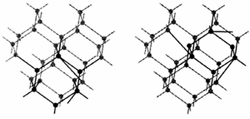
Other patterns could propagate in a similar fashion, andtheir symmetries and interactions matched up perfectly with the knownfundamental particles. Every graph was still just a graph, a collectionof nodes and their mutual connections, but the flaws in the diamondtook on a life of their own.
The current state of the universe was a long way from theDiamond Graph. Even a patch of near-vacuum in the middle ofinterstellar space owed its near-Euclidean geometry to the fact that itwas an elaborate superposition of a multitude of graphs, each oneriddled with virtual particles. And while an ideal vacuum, in all itscomplexity, was a known quantity, most real space departed from thatideal in an uncontrollable manner: shot through with cosmic radiation,molecular contaminants, neutrinos, and the endless faint ripple ofgravitational waves.